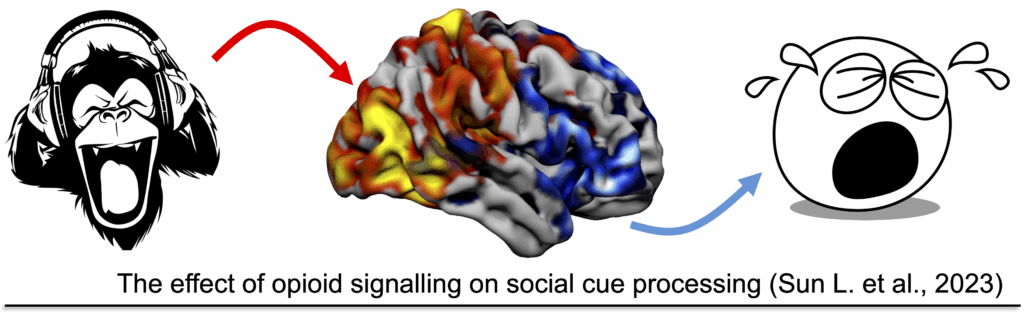
A central aim of our research is to elucidate how the human brain perceives and processes the social world. This includes investigating how biological states facilitate social cognition, as well as how the brain is shaped by cultural influences to mediate social behaviour. Social interaction is inherently complex, involving a dynamic interplay of multimodal cues and naturalistic emotional signals.
Molecular Basis of Social Emotions
Our previous research has advanced our understanding of the endogenous opioid system in mediating social attachment and withdrawal. For instance, laughter stimuli have been used to investigate affiliative bonding, while crying vocalizations have served as models for distress and social disengagement. These social-emotional processes are closely linked to mu-opioid receptor signaling in the human brain (Sun et al., 2023). Additionally, our studies have identified secretin (the oldest known hormone) as a modulator of both reward circuitry, brain-body interactions through glucose signalling, with potential implications for disordered eating behaviors (Sun et al., 2023). The lab’s current focus is on the role of growth hormone in social perception and neurodevelopment. This line of inquiry is particularly relevant given the growing evidence linking dysregulated growth hormone signaling to increased vulnerability to mental disorders.
The Impact of Seasonal Rhythms
A new research direction explores how seasonal affective changes shape social perception. We are initiating a large-scale cohort study involving both healthy individuals and participants with subsyndromal Seasonal Affective Disorder (SAD). These studies will combine behavioral assessments with EEG, fMRI, and PET imaging, aiming to identify neurobiological “fingerprints” of seasonal variation in social cognition within the local population. The ultimate goal is to contribute to a mechanistic understanding of seasonal affective disturbances.
Violence and the Brain
Violence continues to pose a serious threat to social cohesion, establishing it as a key area of inquiry within social cognitive neuroscience. Our earlier work, conducted with clinical populations such as individuals with autism and psychopathy, revealed atypical neural responses to violent stimuli, alongside marked structural brain alterations (Nummenmaa et al., 2021; Sun et al., 2022; Noppari et al., 2022). Building upon these findings, our current research focuses on how the brain perceives and interprets various forms of social violence, including verbal, interpersonal, and culturally specific aggressions. This emerging line of inquiry is being developed through active collaborations with colleagues at the University of Turku, Fudan University and Tianjin Normal University.
Key Publications:
- Lihua Sun, …, Lauri Nummenmaa (2023). Mu-opioid receptor system modulates responses to vocal bonding and distress signals in humans. Philosophical Transactions of the Royal Society B: Biological Sciences, 377(1863).
- Lihua Sun, …, Pirjo Nuutila (2023). Secretin modulates appetite via brown adipose tissue – brain axis. European Journal of Nuclear Medicine and Molecular Imaging
- Lauri Nummenmaa, Lasse Lukkarinen, Lihua Sun, et al (2021). Brain Basis of Psychopathy in Criminal Offenders and General Population. Cerebral Cortex.
- Lihua Sun, …, Lauri Nummenmaa (2022). Aberrant motor contagion of emotions in psychopathy and high-functioning autism. Cerebral Cortex.
- Tuomo Noppari, Lihua Sun, …, Lauri Nummenmaa (2022). Brain structural alterations in autism and criminal psychopathy. NeuroImage: Clinical.
- Severi Santavirta, …, Lihua Sun, …, Lauri Nummenmaa (2023). Functional organization of social perception in the human brain. NeuroImage.